


Hair is not nourished from the outside
When it comes to hair, the focus is often on products, treatments and cosmetic routines.
In fact, one of the most determining factors is nutrition.
Hair is not nourished from the outside.
They form and grow from what the organism receives, transforms and utilises.
“The quality of the hair reflects the quality of what nourishes the organism.”
Understanding the link between nutrition and hair means a complete change of perspective, as explored in the article “Classical vs. integrated trichology: what are the real differences?”.
How nutrition affects hair
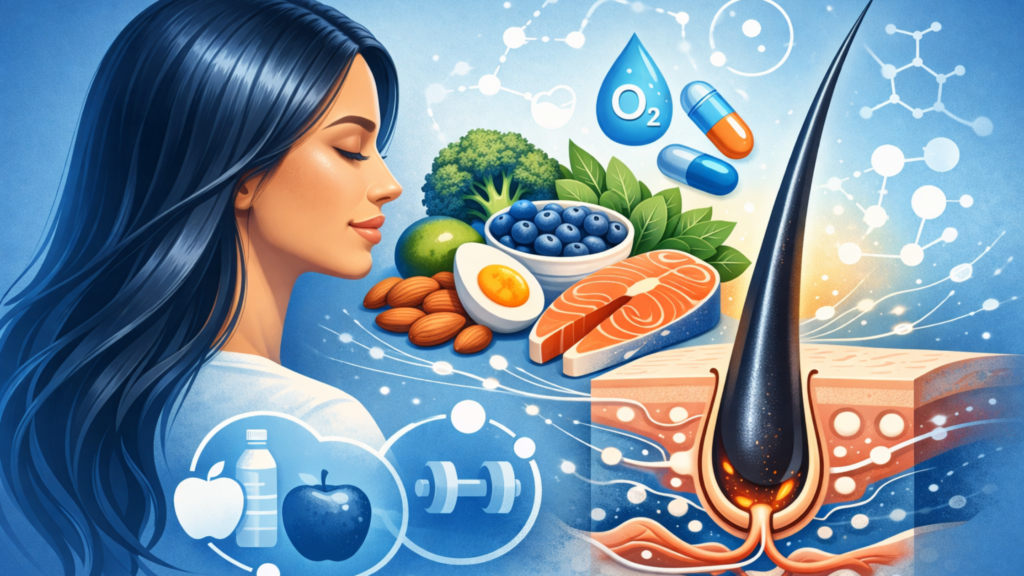
The hair is born in the follicle, which is a metabolically active structure.
To function properly, it needs:
- energy
- nutrients
- oxygenation
- metabolic balance
When one of these elements is missing, the body intervenes with a precise strategy: it gives priority to vital organs.
Hair, not being essential for survival, is “sacrificed”. This explains why hair loss is never an isolated phenomenon, but part of a more complex system, as detailed in “Because hair loss is not just a scalp problem”.”.
 Signs of an unbalanced diet
Inadequate nutrition can quickly reflect on hair quality.
The most common signs are:
- matt hair
- loss of lustre
- slower growth
- greater fragility
- increased fall
These signs should not be interpreted as an aesthetic problem.
They are a message.
Restrictive diets: an underestimated risk
Drastic or overly restrictive diets can have a significant impact.
In the short term, they can cause:
- sudden fall
- loss of density
In the long run:
- weakening of the hair
- slowdown in growth
The body perceives restriction as stress, and this can also contribute to thinning, as explained in “Thinning hair: when to really worry?”.
Nutritional deficiencies and hair
Proteins: the structure of the hair
The hair is mainly composed of keratin, a protein.
A protein deficiency can lead to:
- weak hair
- reduction in growth
- greater fall
B vitamins
B vitamins are involved in energy processes and cell regeneration.
A deficiency can cause:
- fine hair
- loss of vitality
- slowing of the hair cycle
Minerals
Elements such as iron, zinc and magnesium are essential.
When they are missing, they can be observed:
- hair loss
- brittle hair
- reduced regeneration capacity
Nutrition and inflammation
It is not just a question of shortages.
Certain foods may favour inflammatory states.
In particular:
- excess sugar
- ultra-processed foods
- low-quality fats
These factors may contribute to:
- sebum alteration
- skin instability
- worsening of hair quality
This link is fundamental to understanding what we explore in the article “Inflammations: the hidden cause”.
Gut and hair: a direct link
The intestine plays a key role in nutrient absorption.
When it does not work optimally:
- nutrients are not assimilated properly
- increases the inflammatory state
- the overall balance is disturbed
As a result, hair also suffers.
Nutrition, sebum and skin
Nutrition also affects sebum production.
An unbalanced diet can lead to:
- excess sebum
- altered sebum
- more responsive skin
This creates a less favourable environment for the hair. For more on this, see also “Sebum: why it should not be eliminated but rebalanced”.
The role of lifestyle
Power is not an isolated element.
It is closely related to:
- sleep quality
- stress management
- physical activity
A correct diet, without overall balance, is not enough.
What promotes healthy hair
A balanced approach includes:
- food variety
- quality of raw materials
- macronutrient balance
- attention to digestion
There are no “superfoods”.
There is a system that has to work.
Most common errors
Among the most frequent errors are:
- focusing on supplements without working on nutrition
- follow unbalanced diets
- ignoring body signals
These approaches do not solve the problem and often only lead to acting on the effects, as is also the case with damaged hair, a topic explored in “What ruins hair?”.
Nutrition and hair: an integrated approach
The integrated holistic trichology approach considers nutrition as part of a larger system.
It is not just about “what to eat”, but about:
- how it is assimilated
- how stress is managed
- how metabolism works
This allows action to be taken on the actual causes. In this process, a professional assessment can also help to read the signs of the skin, as explained in “How a professional trichological assessment works in VTI centres”.
When it is useful to consult a nutrition specialist
In some cases, working on the power supply alone is not enough.
When signs persist or are particularly evident, the support of a nutritionist or dietician can make all the difference.
It is useful to consider further study when:
- hair loss is intense or prolonged
- suspected or confirmed nutritional deficiencies are present
- the diet is very restrictive or disordered
- digestive or intestinal disorders are present
- major alterations in sebum or hair quality are observed
A specialist can help:
- identify any nutritional imbalances
- setting up a customised food plan
- support metabolic rebalancing
This type of intervention does not replace work on the skin, but complements it.
An integrated approach makes it possible to act on both internal causes and external manifestations.
Link between nutrition and hair
The link between nutrition and hair is direct.
Hair is not isolated.
They are part of a system.
Understanding this means moving from a superficial approach to a more conscious one.
“Healthy hair is the result of an organism that functions in balance”.”


